April 28, 2006 Friday
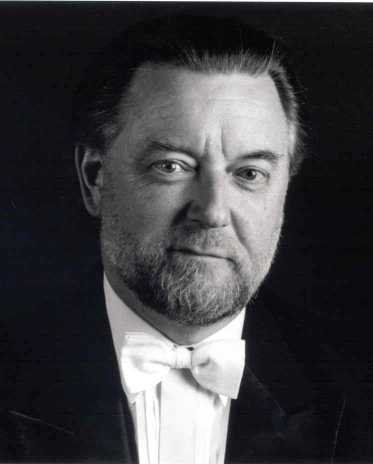
Sir Andrew Davis Conductor
Ralph Vaughan Williams The Lark Ascending
Andres Cardenes/Violin
Dmitri Shostakovich Symphony No. 9 in E-flat Major
Intermission
Ludwig Van Beethoven Concerto No. 3 in C Minor for Piano and Orchestra
Emanuel Ax/Piano
Richard Wagner Overture to Tannhauser
------------------------------------------------------------------------
In the pre-concert tutorial, Emanuel Ax and Sir Andrew Davis played Faure’s “Dolly Suite” together. Both dressed in casual. Sir Davis had a black V-neck knit sweater which loosely covered his big belly. Mr. Ax was wearing a light blue sweater, a pair of old black shoe contrasted with white socks.
 Emanuel Ax speaks very softly as if every syllable is rounded like a refined note (He studied French in Columbia University). When he speaks, he is as charming and humorous as modest and even humble at the same time. Faure’s four-hand lovely pieces served more like a warm-up for the coming Beethoven Piano Concerto and definitely there was little rehearsal beforehand. To address that, he said: “Faure’s work is beautiful. But sometimes there are some unusual harmonies. I just want to let you know that, hmm, not all that sounds strange is the mistakes we’ve made.”
Faure’s Dolly Suite is very family oriented with an amicable feeling. The second piece is even titled “Mi-a-ou” as Sir Andrew Davis pointed out, but it was the first piece “Barbeque” that soothed audience and performers. The fact that the work is relatively easy in technique freed both from delving hard into the notes. They skimmed through the program and chose the first take of each movement straightforward. The cordial tempo touches a sense of improvisation, therefore the four-hand work, to some degree doubled the pleasure of both audience and pianists.
Emanuel Ax plays the piano in an unusual expressive way. He can communicate what he feels though his fingers (not from his facial and gesture performance) and as an ardent chamber music player, he “talks” with orchestra instead of “speaks” by himself. He is a pianist of least percussion style in that he strings those long sentences naturally and makes each cantabile.
I am not a fan of his tone color however. In Beethoven’s piano concerto, mostly the sound was well-rounded and polished, smooth but lack of nuance. But in the slow movement, he skimmed the keyboard and sustained the damper pedal half way to make hazy sound. The gossamer texture from this tranquil section was surprisingly sensual.
This echoed to how Mr. Ax and Mr. Davis treated the whole Beethoven’s work. Actually Beethoven gave up concerto style at fairly early stage. He must have sensed that the symphonic style intrinsic to concertos would finally force the form to merge with symphonies. His successors didn’t solve the problem either. Brahms’ two piano concertos are more like symphonies with piano accompany while Chopin put orchestra as mere background support. The third piano concerto was a work of Classicism vs. Romanticism. Although bound in a classical form, Beethoven’s emotional expression is in essence romantic, full of enriched color, surprising harmonies and astonishing energy. Mr. Ax inclined to a more romantic interpretation. His recapitulation was more forceful than expected and his second movement was slower. The balance in Classicism was broken by Sir Davis’ less pushing manner. Mr. Davis let the groove come onto the orchestra and didn’t push it to a vivacious status. As a result, the orchestra, although full of colors, was light-weighted and simply made piano sound more eminent.
Emanuel As returned to the stage and played Chopin as an encore. The encore unfortunately was accompanied by the fireworks from PNC Park after the baseball game. Nevertheless it was so breathable and charming. That made me wondering what is the criterion that who should be included in the “Great Pianists of 20th Century” series. American pianists are well represented by Earl Wild, Byron Janis, Van Cliburn, William Kapell, Stephen Kovacevich, Julius Katchen and Andrew Watts. But Emanuel Ax, the winner of the first Arthur Rubinstein Piano Competition is not in the list. It is true that Ax spent more time collaborating with other musicians like Yoyo Ma, Isaac Stern, Peter Serkin in chamber music so that his solo career hasn’t been really big, but some listed pianists haven’t convinced me their superiority either from CD or from their concerts.
To everyone’s surprise, Lark Ascending by Vaughan Williams was actually the first PSO’s subscription performance. My friends said it sounded like new age music. (I personally once used it as background music for poem recital.) Shostakovich’s No. 9 Symphony is new to me. I read the program notes and understood the dark, sardonic meaning behind the magic number No. 9. However, I always have difficulty in connecting to Shostakovich’s work from heart. Always does it give me cold feeling under composer’s magnificent technique as if the political background has intrinsically weaved into music thus eliminates any deep personal confession. Interestingly, 2006 is 100th anniversary of Shostakovich’s birthday and his works are now performed throughout the world. There are more his works coming in the next music season and hopefully I can learn more in future.
In the pre-concert tutorial, Emanuel Ax and Sir Andrew Davis played Faure’s “Dolly Suite” together. Both dressed in casual. Sir Davis had a black V-neck knit sweater which loosely covered his big belly. Mr. Ax was wearing a light blue sweater, a pair of old black shoe contrasted with white socks.
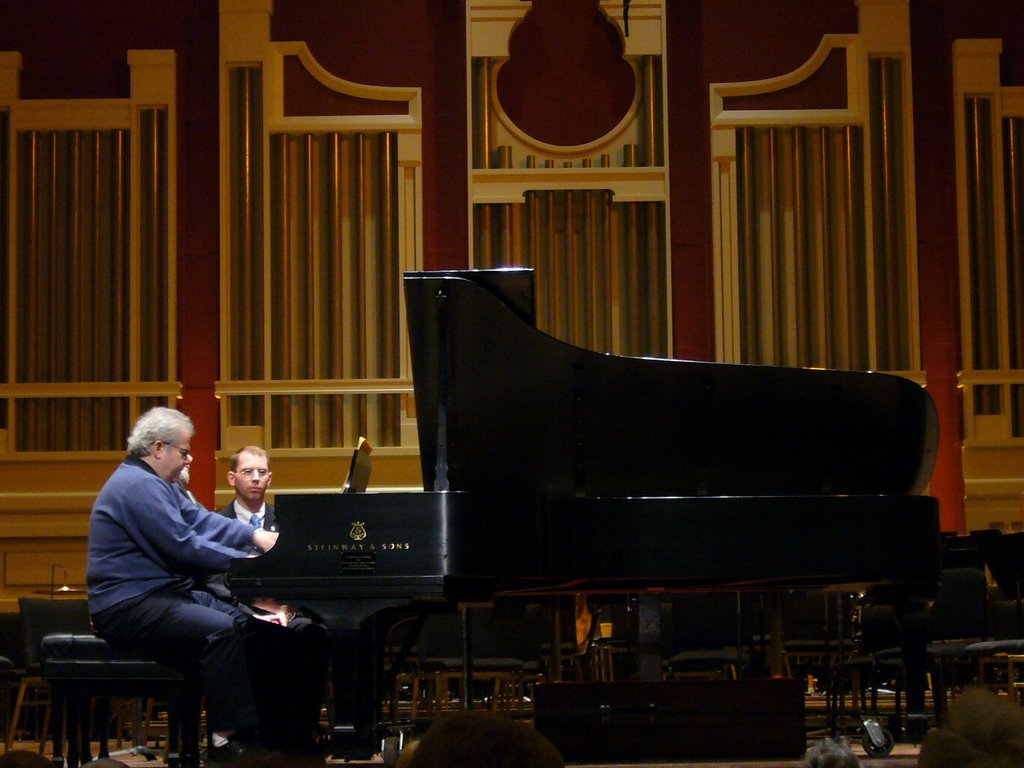 Emanuel Ax speaks very softly as if every syllable is rounded like a refined note (He studied French in Columbia University). When he speaks, he is as charming and humorous as modest and even humble at the same time. Faure’s four-hand lovely pieces served more like a warm-up for the coming Beethoven Piano Concerto and definitely there was little rehearsal beforehand. To address that, he said: “Faure’s work is beautiful. But sometimes there are some unusual harmonies. I just want to let you know that, hmm, not all that sounds strange is the mistakes we’ve made.”
Faure’s Dolly Suite is very family oriented with an amicable feeling. The second piece is even titled “Mi-a-ou” as Sir Andrew Davis pointed out, but it was the first piece “Barbeque” that soothed audience and performers. The fact that the work is relatively easy in technique freed both from delving hard into the notes. They skimmed through the program and chose the first take of each movement straightforward. The cordial tempo touches a sense of improvisation, therefore the four-hand work, to some degree doubled the pleasure of both audience and pianists.
Emanuel Ax plays the piano in an unusual expressive way. He can communicate what he feels though his fingers (not from his facial and gesture performance) and as an ardent chamber music player, he “talks” with orchestra instead of “speaks” by himself. He is a pianist of least percussion style in that he strings those long sentences naturally and makes each cantabile.
I am not a fan of his tone color however. In Beethoven’s piano concerto, mostly the sound was well-rounded and polished, smooth but lack of nuance. But in the slow movement, he skimmed the keyboard and sustained the damper pedal half way to make hazy sound. The gossamer texture from this tranquil section was surprisingly sensual.
This echoed to how Mr. Ax and Mr. Davis treated the whole Beethoven’s work. Actually Beethoven gave up concerto style at fairly early stage. He must have sensed that the symphonic style intrinsic to concertos would finally force the form to merge with symphonies. His successors didn’t solve the problem either. Brahms’ two piano concertos are more like symphonies with piano accompany while Chopin put orchestra as mere background support. The third piano concerto was a work of Classicism vs. Romanticism. Although bound in a classical form, Beethoven’s emotional expression is in essence romantic, full of enriched color, surprising harmonies and astonishing energy. Mr. Ax inclined to a more romantic interpretation. His recapitulation was more forceful than expected and his second movement was slower. The balance in Classicism was broken by Sir Davis’ less pushing manner. Mr. Davis let the groove come onto the orchestra and didn’t push it to a vivacious status. As a result, the orchestra, although full of colors, was light-weighted and simply made piano sound more eminent.
Emanuel As returned to the stage and played Chopin as an encore. The encore unfortunately was accompanied by the fireworks from PNC Park after the baseball game. Nevertheless it was so breathable and charming. That made me wondering what is the criterion that who should be included in the “Great Pianists of 20th Century” series. American pianists are well represented by Earl Wild, Byron Janis, Van Cliburn, William Kapell, Stephen Kovacevich, Julius Katchen and Andrew Watts. But Emanuel Ax, the winner of the first Arthur Rubinstein Piano Competition is not in the list. It is true that Ax spent more time collaborating with other musicians like Yoyo Ma, Isaac Stern, Peter Serkin in chamber music so that his solo career hasn’t been really big, but some listed pianists haven’t convinced me their superiority either from CD or from their concerts.
To everyone’s surprise, Lark Ascending by Vaughan Williams was actually the first PSO’s subscription performance. My friends said it sounded like new age music. (I personally once used it as background music for poem recital.) Shostakovich’s No. 9 Symphony is new to me. I read the program notes and understood the dark, sardonic meaning behind the magic number No. 9. However, I always have difficulty in connecting to Shostakovich’s work from heart. Always does it give me cold feeling under composer’s magnificent technique as if the political background has intrinsically weaved into music thus eliminates any deep personal confession. Interestingly, 2006 is 100th anniversary of Shostakovich’s birthday and his works are now performed throughout the world. There are more his works coming in the next music season and hopefully I can learn more in future.