Saturday, April 29, 2006

CSO Appointed Principle Conductor


BERNARD HAITINK APPOINTED AS PRINCIPAL CONDUCTOR OF THE CHICAGO SYMPHONY ORCHESTRA
PIERRE BOULEZ NAMED AS CONDUCTOR EMERITUS OF THE CHICAGO SYMPHONY ORCHESTRA
Two internationally renowned conductors assume key leadership roles within CSO artistic team while music director search continuesThe CSO Association today announced that it has appointed two of the world’s greatest conductors to titled positions with the Chicago Symphony Orchestra. Eminent Dutch conductor Bernard Haitink has been appointed as the Orchestra’s new Principal Conductor. Renowned French composer and conductor Pierre Boulez—the CSO’s current Helen Regenstein Principal Guest Conductor since 1995—has been named as Conductor Emeritus of the Chicago Symphony Orchestra. Both appointments will be effective at the start of the 2006-2007 season.

“The Chicago Symphony Orchestra family is very excited to celebrate both its newly formed relationship with Bernard Haitink and the continuation of its long standing relationship with Pierre Boulez,” said Deborah R. Card, President of the CSO Association. “Our strong commitment to maintaining the high quality of music making for which the CSO is known is further strengthened by the appointment of these two distinguished masters. We are thrilled that these gentlemen have agreed to collaborate with us as key members of the CSO’s artistic team.”

“As our music director search moves into its next phase, we are extremely pleased that Mr. Boulez and Mr. Haitink have accepted these new titled positions with the CSO. It is an honor to have musicians of such an extraordinary caliber working in these capacities,” said William H. Strong, Chairman of the CSO’s Board of Trustees and Chair of the CSO Music Director Search Committee. “Our search committee continues to find great inspiration in the knowledge that the best artists from around the world are so enthusiastic about working with our Orchestra. We remain energized in our music director search to select the best musical leader who is the right match for the CSO. We intend to take the time necessary to make a decision that will best serve our Orchestra and our city in the long term.”

“The Chicago Symphony Orchestra members who serve on the Music Director Search Committee are incredibly pleased with this announcement,” said CSO Assistant Principal Oboe Michael Henoch, on behalf of the musicians of the committee. “We hold Pierre Boulez in great esteem. For many years, he has conducted the CSO with the highest distinction as our Principal Guest Conductor. We are most grateful to him for the loyalty and dedication he has shown the Orchestra in agreeing to fulfill many administrative duties in coming seasons as well. Our admiration for Bernard Haitink has grown since he first conducted the Orchestra in 1976. He has always been a most welcomed guest conductor in ensuing years. Mr. Haitink’s latest residency this past winter confirmed that a very special relationship has developed between him and the Chicago Symphony Orchestra. We look forward with great anticipation to our future music making with him.”

In his new role as Principal Conductor, Bernard Haitink will lead four to six weeks of CSO performances each season, starting in the 2007-2008 season, including subscription concerts at Symphony Center and tour performances. In addition to his Chicago appearances, Mr. Haitink will lead the Orchestra in future concerts at New York City’s Carnegie Hall, at the prestigious Lucerne Festival in Lucerne, Switzerland, and at London’s BBC Proms. His next scheduled dates with the CSO are in October 2006 when he will conduct the CSO, mezzo-soprano Michelle DeYoung, and the women of the Chicago Symphony Chorus in Mahler’s Symphony No. 3. He will also now return to Chicago in May 2007, leading the Orchestra in Beethoven’s Coriolan Overture, Lutoslawski’s Chain 2 with CSO Concertmaster Robert Chen as soloist, and Bruckner’s Symphony No. 7. Mr. Haitink replaces Manfred Honeck for these performances.

Beginning in 2006-2007, as Conductor Emeritus of the Chicago Symphony Orchestra, Pierre Boulez will conduct three to four weeks of CSO performances each season, including touring activities. As previously announced, the CSO will perform three concerts under his direction at Carnegie Hall this December 2006. These will be complemented by future Carnegie dates. Mr. Boulez next returns to the CSO podium in late November/December 2006 for performances of Mahler’s Symphony No. 7, Bartók’s The Miraculous Mandarin, Ravel’s Valses nobles et sentimentales, and Ligeti’s Piano Concerto with soloist Pierre-Laurent Aimard.

“The Chicago Symphony Orchestra is a truly great orchestra, with an extraordinary legacy and tradition. I am very proud to be a small part of that tradition, and I’m really looking forward to making music with these wonderful musicians,” said Bernard Haitink. Mr. Haitink made his debut with the Chicago Symphony Orchestra in March 1976. He returned to Chicago over 20 years later to conduct subscription performances in January 1997. Most recently, Mr. Haitink led the CSO in a highly-successful two-week Chicago residency in March 2006.

“I am not only pleased, but deeply touched about being named Conductor Emeritus of the CSO,” said Mr. Boulez. “My gratitude and joy go far beyond the title itself because it means a lot to me to continue a fruitful collaboration with these wonderful musicians, and a team and organization of the first magnitude.” The Chicago Symphony Orchestra’s close relationship with Pierre Boulez began with his CSO conducting debut in 1969. Mr. Boulez returned to the Orchestra Hall podium in 1987, and began annual residencies with the CSO in 1991. He was named Principal Guest Conductor of the Chicago Symphony Orchestra in 1995. Since that time, his annual Chicago residencies have been much-anticipated events, exploring landmark works of the 20th century, providing fresh perspectives on established symphonic repertoire, and offering notable premieres of new works. The CSO/Boulez partnership has yielded dozens of commercial recordings, eight of which have been awarded Grammy® Awards.

Mr. Haitink and Mr. Boulez will provide input as to the overall artistic growth of the CSO. Mr. Haitink will lend his expertise and ideas on artistic matters. Beginning in 2006-2007, Mr. Boulez will assume additional behind-the-scenes responsibilities, working with the musicians of the Orchestra and management team, participating in auditions for open positions, and assisting with personnel issues as they arise.

Looking ahead, music making with Bernard Haitink and Pierre Boulez will serve as the foundation for exciting future CSO seasons. Further reflecting efforts to build strong, continuing relationships with great artists, an outstanding roster of internationally acclaimed guest conductors will join the CSO in 2007-2008, including but not limited to (in alphabetical order): Semyon Bychkov, Myung-Whun Chung, Christoph von Dohnányi, Charles Dutoit, Mark Elder, John Elliot Gardiner, Valery Gergiev, Alan Gilbert, Miguel Harth-Bedoya, Riccardo Muti, Kent Nagano, Antonio Pappano, David Robertson, Mstislav Rostropovich, Esa-Pekka Salonen, and Michael Tilson Thomas. In addition to tours with Mr. Boulez and Mr. Haitink, the Chicago Symphony Orchestra will embark on a two-week European tour under the direction of Riccardo Muti in fall 2007. Full details for the Chicago Symphony Orchestra’s 2007-2008 season, including artists, concert programs, and tour itineraries will be announced in February 2007.

Thursday, April 27, 2006

Yundi in Jordan Hall


I went to Bean town for 110th Boston marathon, but luckily caught Yundi’s annual US tour in Jordan Hall. In a super hot (all sold-out) concert and a super hot music hall (no air-conditioning), Yundi gave a super hot performance of Mozart, Schumann, Liszt and Chopin.

Yundi is called a pianist in progress. After winning first award in Chopin International Piano Competition in 2000, he studied with Arie Vardi at the Hannover Conservatory of Music. Since he only tours US once a year, American audience can hardly listen to him in person.

Yundi’s recitals haven’t been an exploration to broaden his repertoire. Instead, he only plays what has been recorded before. So far, his recital program is limited to only a few composers, but his latest released CD shows a great leap into maturity. And as usual, the concert night features almost the same program as the CD.

Mozart, Schumann, Liszt and Chopin, to put works from different composers together at one night provides a great challenge to the recitalist. Pletnev’s Carnegie Hall debut in November of 2000 gave an even more dazzling performance ranging from Bach, Beethoven to Chopin, Rachmaninov and Scriabin. But Pletnev is never labeled as specialist in some composer or some period. He is universal in that his Liszt is dramatic, his Chopin refined and thoughtful and his Tchaikovsky virtuoso and creative. But as the youngest winner of Chopin Competition, Yundi is nevertheless regarded as a Chopin master in the next generation. He has been somehow restrained by this fame and for the first few years, his DGG recording had only been limited to Chopin and Liszt before his Vienna recital was released. And the Jordan Hall night showed his potential to Bostonians.

Jordan Hall was almost all wood inside with a high dome ceiling. It is said the music hall secretly lost its charming acoustic sound stage after the overhaul in 1995. But my concern was somewhere else on the night because Jordan Hall was packed with Asian faces, mostly Chinese, or more precisely, Chinese parents with their children. Unfortunately those kids are too young to sit quietly for two hours; they released their energy in applaud relentlessly during the break between each movement. That definitely affected Yundi’s Mozart.

Yundi played the first movement in a flexible breadth backboned with his understanding in structure. His tone was beautiful as usual and his clarity not scarified by the tempo. Unfortunately he somehow over-controlled the piece regarding to expression and volume. Unlike Horowitz, he seldom let notes pop out like fresh spring from no where and every transition was well sensed and expected in advance. It is true that at the age of 83, Horowitz played Mozart more youthful and fresh than Yundi of 24, but the comparison is a little bit unfair since it can be stated that Horowitz’s legendary performance is more youthful than that of anyone. Yundi’s “Andante Cantabile” was a little bit rush at first, but gradually breathed into gentleness and tranquility. He was poetic, refined and natural. It was some moment that I will not forget for years.

Schumann’s “Canaval” suddenly brought the audience into a more theatrical music world and that was necessary considering the packed audience in sweltering hall. Instead of creating a kaleidoscopic array of colors and characters, Yundi played it with little break as if there was strong evidence of internal connection between pieces. He built the power not through sections of notes, but through several pieces. Therefore when thrilling volume and tempo came to apex, it felt unobtrusive and unmannered.

Liszt’s sonata in B minor has been used as a yardstick to every pianist. There are numerous champions in history for the repertoire from Alfred Brendel to Vladimir Horowitz and it has been played in endless ways by those artists with strong personalities like Argerich or Arrau. It is really hard to speak something new for any next-generation pianist. Yundi, in his booklet of the CD, says he feels deep about the piece and sees a whole life happening in this one movement (Like most, he played the sonata without pause) piece. Yundi played those menacing, even violent motives with grand gesture. He tackled those cascades of double octaves in such a furious-speed, hammering way that one was forced to give in by his mighty power. Li made a few wrong notes near the end, but the technique was almost impeccable and no doubt the performance is almost in release-ready perfection. One may disagree with his performance of those middle sections with haunting beautiful melodies; maybe a little bit more coherence was needed to strengthen the architectural power, but again performance of such a demanding work under such an adverse condition (I suspected the temperature was well above 75 degree later) is marvelous and superb.

Chopin's ''Andante Spianato and Grande Polonaise Brilliante" was Yundi’s most favorable and classic performance ever. With elegance, poetry, dynamics and passion, he won the jury in Chopin piano Competition and also showed how his style would be as he matures. If in future that there is another series called “Greatest Pianists in 21st Century”, then Yundi’s Andante Spianato and Grande Polonaise Brilliante will no doubt be included in his first volume.

People always try to compare Yundi with Langlang. It is true that they share some similarity: both Chinese, both talented, both with spectacular techniques. But it is for sure that they will mature into different types of pianists. I disagree with Fou Ts’ong comments that Langlang is superior to Yundi because they almost play in different music horizon. Langlang is sensational even sensual, outward-expressive, Yundi controlled and refined, thought-inward. To some extent, Yundi is more like Zimmerman who is a romantic perfectionist with formidable precision, while Langlang enjoyed more in live communication under stage light. (That’s why although Langlang’ CDs have only mediocre reviews his concert tour is as hot as ever.) If I have to choose between Yundi with Langlang for one concert, I will choose Langlang because I know there will always be some surprising improvisational moment in Langlang’s concert while Yundi’s concert is as good as his CD. But Yundi’s CD is always worth waiting no matter how long it could be.

Luckily I don’t have to face the challenge of choosing one concert between two. Langlang is schedule to come back to Pittsburgh at season’s finale for Chopin’s No. 1 piano concerto.

Saturday, April 22, 2006

A Night of British


Although Sir Edward Elgar dedicated his violin concerto to Kreisler, it is Yuhudi Menuhin who introduced the contemporary work to the public at the age of 16. In his biography, he describes Elgar’s music as “English” as the flexibility within restraint of a weather which knows no exaggerations except in changeableness. And the response to it of a people able to distinguish infinite degrees of gray in the sky and of green in the landscape never takes either to unseemly extreme.

Half a century ago, Menuhin played the violin concerto under the baton of William Steinberg in the Syria Mosque. At that time outside English only US would welcome Elgar’s music. Today British music still never dominates concert halls but Elgar’s works have been regarded as classic.


Leonard Slatkin stepped in when British conductor Richard Hickox couldn’t make his trip to Pittsburgh, accompanied by superstar Gil Shaham. It was a night of two American artists for two English composers. Surprisingly, it was a feast of sound: warm, spirited for Elgar and imaginative, spectacular for Holst.

I have never quite understood the structure of Elgar’s violin concerto. It is said that Elgar always used separate sheets of manuscript paper so that he could shuffle them at will to compare the piece’s various sections. By the time of recapitulation in the third movement, I’ve usually lost my attention. Mildness is the best way to describe how Slatkin treated the work. The orchestra sound was passionate but not aggressive or vocalic. It had a feeling of wet air from the coast carried from ever-rolling surges of waves. Gil Shaham possessed an attitude of independency and objectivity, just lingering over the orchestra. His tonality was mild and romantic, but never sentimental or too-restrained. The collaboration between the violin and the orchestra seemed seamless in that orchestra was never obtrusive even in assertive section while violinist listened to the conductor attentively for every nuance in volume, phrasing and mood.


Holst’s “The Planets” has definitely been overplayed. Most people enjoyed some famous sections (Part of Jupiter has been used for lots of sports events) in the way of listening to pop music so that it has become commercial music played by an enlarged orchestra. On the other hand, “The Planets” has been undervalued or under-appreciated since seldom do people listen to it in a whole. Slatkin explored the extremity in loudness in PSO for the first movement “Mars”. He made a super crescendo from loud to deafening and the power of the orchestra could blow off the roof of Heinz Hall. After wind section showed its delicacy in Venus, Slatkin made surprising Jupiter interpretation by unique phrasing. Under his baton, it did not has a march tempo but instead carried light unevenness like a weighty wheel spinning and springing on slightly rugged road. When the singing from Women of the Mendelssohn Choir of Pittsburgh floated away in a mystery atmosphere, I suddenly realized what was missing in those dissembled music play: Although each movement is completely different in character, they all share a sense of timeless space, of boundless air. Only by listening to it as a whole can one fully enjoy the craftsmanship in Holst’s magic piece. That makes any attempt to use “The Planets” as Hi-Fi audition shallow and ridiculous.

Wednesday, April 19, 2006

Boston Marathon 2006


As a rookie for the oldest marathon in the world, I felt small and nervous so that in the Guess_a_thon game in Boston Frontrunner party, I wrote down my projected time: 5 hours. I knew that the injury, which prevented me from running more than 40 minutes pain free on Saturday, would play a wild card on the race day (Monday). Training for a marathon has never been easy, but training in winter is extremely hard. I’ve missed so many key workouts for the two months leading to taper period; only averaged about 20-30 miles a week but still ended in physical therapy.

Essentially, Boston Marathon is a race of egoism. Most people run it just because they’ve qualified. In the expo, there was a giant board which showed all bib numbers and left space for runners to fill in their reasons to run. Mostly, the reasons are: “Because it is Boston” or “Because I can”. It was not a good time to ask a less-motivated runner like me to think of reasons to run: there were many reasons I could come up with but none became important when finishing was as unsure as the weather of springtime in New England. I told Eric to think one for me, and he wrote down in a humble font size: Because Minimax cannot do it. (Note: Minimax is my Siamese cat of one and half years old.)

Race day weather couldn’t be better: 50-55 degree and cloudy. The drive to Hopkinton seemed endless (more than 45 minutes). Once I jumped off the shuttle, I saw a boy sitting in front of a table with a sign: Lemonade 50 cents. Hopkinton was as quiet as a battlefield before a war. The seriousness on faces of runners clouded the small town and made me chilling. I knew it was not appropriate even to speak candidly that to finish was my goal. Here everyone looked like a sub-three-hour runner except those sub-three-hour runners who looked like world record holders.

There was another three hours waiting in the runners’ village. One of the former champions from Africa spoke on stage: “Remember, your half point is not 13.1. It starts from mile 18.” I wish I could have remembered that or have read the article about the course of Boston from Runner’s World magazine one year ago. But what’s the point? I even didn’t have a plan unless you call “run until you cannot” a plan.

Boston course is notoriously tricky in that downhills cause damage so early that runners won’t feel it until killer chain (four uphills in a row) looms out after mile 16.5. I tried to hold my pace in the beginning when so many people dashed out like riding a rollercoaster. The first 10K was fairly easy and I could manage a 7:15 pace. Through half point, I began to feel the fatigue in my legs and gradually slowed down to 7:30 pace. Actually I wasn’t expecting that I could run so fast. It was a miracle that the troubled IT Band and right hip didn’t bother me through the course.

Just after mile 16 (Newton Fall), I encountered the first hill. It was steep enough for me to use it as an excuse for a short walk. I crossed the bridge which is the only one of the two places (the other one is an underpass in Back Bay) where there were no spectators since they were not allowed to stand there. Unfortunately, my walk became more and more frequent as the race went by. My pace slowed down to 8 minutes but I still felt quite strong. Then the course suddenly turns right and the third hill abruptly appeared in front of me. A black guy immediately started to walk and I unwillingly joined him. A woman passed me shouting: keep pounding, power walking, keep pounding, power walking! In fact the third hill was not that bad except quite long (almost one mile), I switched between walking and running several times and proudly managed to run it under 8:30 pace. Just before I could get enough rest from flat, another guy ran by with painful expression: “Go ahead, it IS heartbreak!” I knew the last hill was not long, even not very steep. But having conquered three consecutive uphills, my legs got really tired. It was the time to regroup the runners and unfortunately I was one of those that slowed down tremendously.

According to BAA website, Boston Marathon is the second largest single day sport event second to Superbowl in the world and the estimated 500,000 spectators treated runners like superbowl stars. Through the course, I must have seen all people living in New England. They shouted my name, handed me water, orange, banana, iced sponge. But if there is such a group of spectators that really helped me, it should be awarded to people on Heartbreak hill. I was deafened and touched. My legs didn’t stop at all for the last hill.

No sooner had I claimed Heartbreak than my quadriceps suddenly squeezed together like super-heavy melting iron. I knew immediately something must go wrong with them. I stopped and tried to rub them. People shouted at me: “Don’t stop. All downhills from now on!” Yeah, that’s the beginning of a nightmare when both of legs cramps.

I had to take any chance to stop and massage my legs while not disappointing the crowd. Whenever there was someone handed me water, I took it even though I didn’t drink it. From then on, I changed from run with walk to walk with run. At Boston College, some Chinese girls shouted my name together; I tried to run heroically to pass them but must look like a clown because of my distorted form. Along Beacon Ave, I knew 3 hour 30 minutes was not possible since I was still slowing down. As the bronze medal female winner from Japan later said: Where is the heartbreak? It seems every hill is very tough. The course map didn’t reflect the elevation change for the last four miles, but my leg muscle now could detect any nuance on the ground. I looked miserable and the idea of quitting appeared several times. I asked a guy for water and was told that all he had was beer. Nevertheless I grabbed the beer to pour onto legs. To win their laugh, I drank the rest of beer and saluted to him. All people around began to shout my name like welcoming a hero.

At mile 25, Eric spotted me when I was running like mud. Every step became a torture while the CITGO sign from finish line seemed to be always just one mile away. The last half mile was elevated but sad at the same time. It was overwhelming feeling to be able to muster the last strength from legs to run a few blocks. My final time (3:37) was not really bad, but finishing it in such an ugly way was something I had not expected. In short, I finished the first half in 1 hour 36 minutes while the second half took the toll of more than 2 hours. The last 4 miles costs almost one hour. I have never thought that I could run as slow as 13 minutes per mile before!

I struggled to get my medal and refused to get on a wheelchair even though I couldn’t walk straight afterwards. Most of the runners around me had the bib number around 8000 which means about 3500 people passed me in the race. Ironically, I didn’t really encounter the wall because I still had energy in tank, but my legs were totally dead due to lack of training.

Sitting here with soreness in legs and bittersweet memory in head, I remember at the start line, a guy carrying a digital camera took pictures of everything he could. He explained that this was his first Boston and would be last one. He had every reason to just enjoy it. Before heading to Boston, I told Eric that I probably would only try Boston once since its noon-start and course elevation change are not good for breaking personal record. But having finished my Boston debut in such a way, I am eager to train for another Boston. Because, I know from my heart, what Heartbreak hill really broke was only my legs, not my heart. I can and will conquer those hills in a victorious way. And I owe all those fantastic spectators who tried so hard to cheer me up when I was sadly walking head down.

As it says, there is no worse form of failure than failure to try. I did try Boston and claimed the medal. And failure is only the opportunity to begin again more intelligently. Next time, I will do it better. I have marked the date of next year’s Boston Marathon down in the calendar.

Saturday, April 08, 2006

Song of the Earth (Stanza in both English and Chinese)


1
悲歌行 李白

悲来乎,悲来乎。
主人有酒且莫斟,听我一曲悲来吟。
悲来不吟还不笑,天下无人知我心。
君有数斗酒,我有三尺琴。
琴鸣酒乐两相得,一杯不啻千钧金。

悲来乎,悲来乎。
天虽长,地虽久,金玉满堂应不守。
富贵百年能几何,死生一度人皆有。
孤猿坐啼坟上月,且须一尽杯中酒。

悲来乎,悲来乎。
凤凰不至河无图,微子去之箕子奴。
汉帝不忆李将军,楚王放却屈大夫。

悲来乎,悲来乎。
秦家李斯早追悔,虚名拨向身之外。
范子何曾爱五湖,功成名遂身自退。
剑是一夫用,书能知姓名。
惠施不肯干万乘,卜式未必穷一经。
还须黑头取方伯,莫谩白首为儒生。


Tale of Sorrowful Song --- Li Bai

Sorrow comes; sorrow comes
Host has wine; pour not yet
Listen to my singing a sorrowful song
Sorrow approaches, neither sob nor laugh
This world - nobody knows my heart
You have several measures of wine,
I have three-foot lute
Lute playing complements happy drinking
One drink equals thousand taels of gold

Sorrow comes; sorrow comes
Everlasting as the heaven and the earth
Yet roomful of gold and jade shall not last
Hundred years of wealth amounts to what?
Everyone lives and dies only once
Lonely ape sits, howls the moon over the grave
Must empty this cup of wine in one gulp.

2
效古秋夜长 钱起 
 
秋汉飞玉霜,北风扫荷香。
含情纺织孤灯尽,拭泪相思寒漏长。
檐前碧云静如水,月吊栖乌啼鸟起。  
谁家少妇事鸳机,锦幕云屏深掩扉。
白玉窗中闻落叶,应怜寒女独无衣。

Imitation of Old Poem: Long Autumn Night ---Qian Qi

Autumn sky, jade-like frost drifting
Northerly wind carries lotus fragrance
With love, weaving till the lonely lamp fades
Wipe tears, fond memory, long cold night
Eaves edge, blue clouds pure like water
Rising moon, roosting birds caw; geese soar.
Whose young wife is weaving love birds on her loom?
Deeply concealed by silk curtain and inlaid screen
Listening to falling leaves by the white jade window
Pity the woman, chilled and alone without company

3
宴陶家亭子 李白

曲巷幽人宅 高门大士家
池开照胆镜 林吐破颜花
绿水藏春日 青轩秘晚霞
若闻弦管妙 金谷不能夸

Banquet at Tao’s Family --- Li Bai

PavilionWinding path; private residence in quietude
Tall gate; great scholar’s home
Open pond mirrors reflection
Protruding forest trees intersperse with colorful flowers
Turquoise water hides the Spring sun
Green room camouflages evening amber
If strings and woodwinds are delightful to hear,
Unmatched by “golden valley”

4
采莲曲 李白
若耶溪边采莲女,笑隔荷花共人语。
日照新妆水底明,风飘香袖空中举。
岸上谁家游冶郎,三三五五映垂杨。
紫骝嘶入落花去,见此踟蹰空断肠。

Lotus-plucking Song --- Li Bai
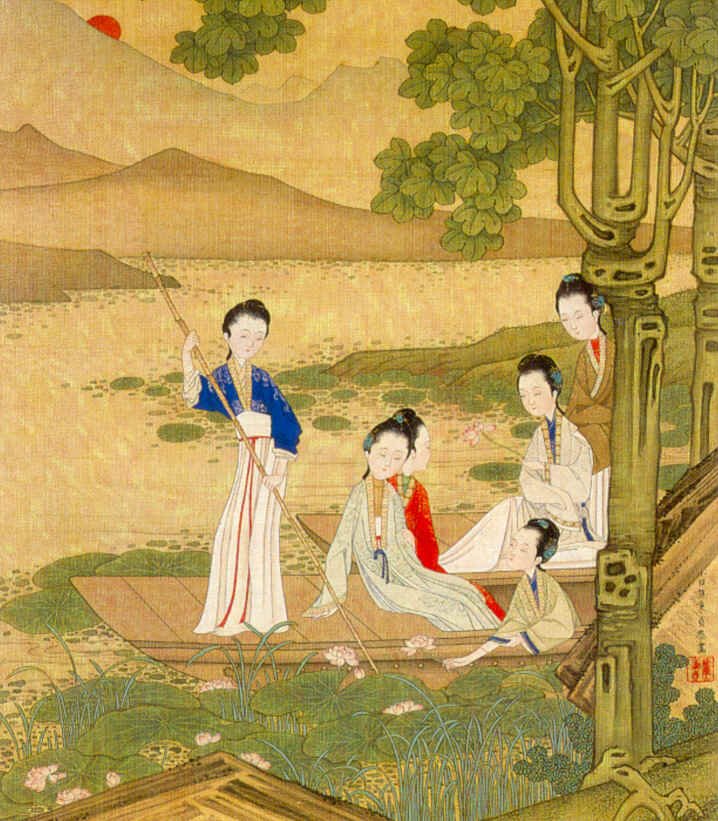
By Ruo-Ye* Brook, lotus-picking girls
Laughter and chatters among lotus flowers,
Sun shines on the painted beauty – clear in the water
Breeze lifts fragrant sleeves in the air
At the bank, who are the wandering young men
Gathering in threes and fives by the willows
Purple horses neighing pass, flowers fallen
Witnessing this, troubled and lament in vain

5

春日醉起言志 李白
处世若大梦,胡为劳其生。
所以终日醉,颓然卧前楹。
觉来盼庭前,一鸟花间鸣。
借问此何时,春风语流莺。
感之欲叹息,对酒还自倾。
浩歌待明月,曲尽已忘情。

Feelings upon Awakening from Drunkenness on a Spring Day --- Li bai

Earthly life resembles big dream
Pointless slaving oneself
Hence drunken all day
Crouching, disheartened, at the front pillar
Stare before the courtyard upon awakening
A bird sings among the flowersAsk: what season is this?
The nightingale speaks of Spring breezes
Moved, one desires to sigh
Facing the wine, pour for oneself
Singing loudly, awaiting the moon
Song ends, feelings forgotten

6
Staying at Teacher’s Mountain Retreat, Awaiting a Friend in Vain ---Meng Haoran

Dusk sun passes the western peak
Valleys have suddenly darkened
moon above pine trees chills the night
wind, brook, filled with clear sound
woodcutters are almost all home
birds, in mist, are roosting
The man expected to stay the night has not yet come
lonely lute awaits at rattan trail

送别 王维
下马饮君酒,问君何所之。
君言不得意,归卧南山陲。
但去莫复闻,白云无尽时。

Farewell---Wang Wei

Dismount horse, drink your wine
Ask you: "Where to?"
You say: "At odds with the world
Return to rest by the South Hill."
Please go. Ask no more.
Endless, the white clouds.

山中送别 王维
山中相送罢, 日暮掩柴扉。
春草明年绿, 王孙归不归。

Farewell in the Mountain ---Wang Wei
Bid each other farewell in the mountain
Closing wooden gate at dusk
Spring grass green again next year
Will the honored friend return?

Das Lied von der Erde (Song of the Earth)


Pittsburgh Symphony Orchestra hasn’t performed Mahler’s “Das Lied von der Erde” or Song of the Earth (SOE) for almost 30 years. Sir Andrew Davis said that was actually William Steinberg’s favorite piece. If fact, Mr. Steinberg chose SOE in his last farewell concert and the music ended at the melancholy singing from mezzo-soprano of “forever… forever.”

Pittsburgh Symphony Orchestra must remember such a moving moment (at least some of the members have gone through Steinberg, Previn, Maazel and Jansons regimes), and the night of Song of the Earth reminded me the livelong dream of contemplation about death and life.

When Mahler speaks in a soft voice, the music is celestial and otherworldly. The motive from the sighing harp echoed by the demurring brass and haunting percussion in the last movement “Parting” consummates all the feelings expressed in the previous movements. Sir Andrew Davis brought out such nuance and delicacy from PSO that the audience stayed silent long after the last music note.

The tenor Jason Collins faced some difficult jobs in singing against roaring orchestra. Mostly I couldn’t hear him clearly due to my seat position. The third movement “Of Youth” showed his vigorous voice and nimble tonality, but Mahler’s SOE is a symphony highlighting mezzo-soprano (or baritone in Bernstein’s case). Jane Irwin won 1991 Decca Kathleen Ferrier Prize and any mezzo-soprano has to face with the legend historical performance by Ferrier. Luckily Jane has a better sound stage and her voice is soft and smooth, with a sense of stillness lingering around, just perfect for decaying stark atmosphere in “The Lonely One in Autumn”. Her singing of the “Parting” was unforgettable. It was not deep sorrow feeling in the end. She instilled the sweet sorrow, as if it resulted from a combination of resignation of inevitable death and a willingness of accepting death as part of life cycle. In the end, she sang the last “Ewig” with tender smiles, and I did wish at that moment it would mean “forever… forever”.

The concert proves what I have believed about Mahler. Mahler can hardly be experienced in canned music format. The dynamic, the scale, the orchestration can only be fully enjoyed live. PSO’s Mahler No. 5 almost blew me out of the seat two years ago. Then Barenboim’s last conducting of Mahler in Chicago showed restrains and balance for the same piece. Ferrier’s parting under Bruno Walter’s baton missed the misty echoing from orchestra in DECCA’s CD, it was PSO and Jane Irwin (mezzo soprano) that brought me back to realize the greatness of the masterwork.

Thursday, April 06, 2006

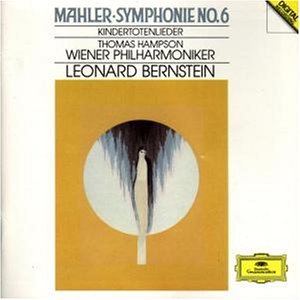
Lenny's Mahler


It always amazes me to realize the importance of interpreters, something unique for music appreciation only. Mahler composed his works in great detail and instructions so that there is almost no middle land between keeping strictly to music notes and straying far away. Stravinsky prefers the former and hates unwanted personalization from interpreters, but unfortunately the greatness of the music lies in the infinite ways of exploration, understanding and recreation. For me, Boulez and Bernstein show two extremes with regard to Mahler’s world. It is the latter composer who approached Mahler with more Mahlerian sensitivity and thereby conquered me.


I don’t have his last complete Mahler cycle, but own a few. The Symphony No. 6 is acquired yesterday, which I haven’t had the chance to listen that much. It is already a wonder for Lenny Bernstein to conduct Mahler at his age when these live recordings were made, not to mention this cycle is the most dynamic, most vigorous and most emotional one. In my mind, although he may have distorted more notes than other conductors, no one, in terms of music character, is closer than he to Mahler.


I take extreme freedom to use Mahlerian which is hard to explain in a few sentences. It can be fragile and brittle, boisterous and rough, heroic and lofty. No matter what feeling it is, it bursts out without restraint. From my point of view, music from Mozart is so wholesome and chaste that it cannot be the final resort for peace and serenity. It just sounds too beautiful to be real. Mahler murmurs, shouts, contends, retreats and cries. His music embodies a heroic statue with all human weakness, thus listening experience becomes mutual consoles, with equality.

Mahlerian concept is the key to accept Bernstein’s boldness. There is no such too much emotion involved to perform extremely emotional music; and there is no overloading conducting for overloading music. It is a final outlet and a retreat so that no strong feelings should be inhibited. Lenny makes the Allegro of the first movement of Resurrection into a heroic trudge, he opts a much faster tempo for funeral march in Titan which sounds humorous and idiosyncratic. He chooses a boy to substitute a soprano in the finale of 4th symphony, and No. 6 Symphony, he blows down the audience by strokes of “hammer” with no mercy.


Also, an old article written three years ago.
_______________________________________________
聆听Mahler确实不是一件简单的事情,我首先必须承认我的一个缺点:每次聆听Mahler都会走神。在宏大冗长的音流中flounder应该不是罪过,但缺乏心灵的契合确是不得否认的事实。

Mahler说,我的时代终会到来。上个世纪末全世界的乐团都在拥簇Mahler,连上交也请来了Kaplan首演了Resurrection。一时间, Mahler的音乐中的深刻在现代社会中找到了最好的注解,他对于音乐中的心理因素的洞悉以及他对严肃哲学命题的思索使得他的交响曲成为许多知识分子的心灵慰藉。

诚然如此,我依然不能热爱Mahler,甚至我更喜欢同样冗长、宏大的Bruckner。我一直认为,音乐的艺术不应受到道德的束缚,更无需言及深刻或哲理。他们未尝不会没有交集,但交集的本身不能代表音乐作品的“崇高“。

前天晚上,朋友到我家里拿去几张昆曲的VCD,他即将毕业,已经找到一份在DC的工作。我们聆听着Mozart的小提琴奏鸣曲,Grumiaux的琴下Mozart简单纯朴。他听着听着,竟似失了魂一般,然后喃喃的诉说起来自己过去两年的艰难:连续两次被lay off,2001年就搬了5次家,从加州一路到康州,尽是焦急地等待。为了保持留美的身份,他终于决定自费在名校读一个好一些的专业,卖了车,贷了款,借了债,高昂的学费迫使他必须尽可能的争取在一年修完,于是一个学期要上六门课;即使这样,低迷的经济依然让他担心未来的工作。而今,似乎两年的郁闷阴霾都会化去,心中宽慰舒坦了许多,却仍因为过去的沉重而感到些许的谨慎和忧虑。“你听,Mozart好像不食人间烟火一样,从来没有过忧愁,可是。。。“

我知道他的后句,不禁想起Shostakovich说过的,音乐是人类最后的避难所;而Mozart的音乐应是终极的慰怀吧。那个深夜,我仍聆听着他的小提琴奏鸣曲,音乐简洁如一汪清水,幽蓝潭底清澈见底,那般纯净世间又何处可循呢?不由得感动的要落泪。

回到Mahler的论题中,我可以陶醉于其中的某些片断,却无法凝神欣赏全貌。记得在Barbirroli的一张唱片的Booklet中,作者甚至用到了Mahler式的神经质一词,这个词语直观的表达了Mahler音乐的某些瞬间,不同情感要素积聚压缩后突然的爆发和释放,从而带给听众的心理映射。在后现代的工业社会激烈的竞争、忙碌的奔波中,人类比以往更需要情感的宣泄。Mahler用其浩大的配器,错综的声部可以生生在心中砸出一个口来,人生五味浊污一般一拥而出。这种品啜因为触及内心深处而引发的苦痛带来的近乎病态的愉悦,在强烈的管弦乐音响洪流的冲击下久而久之让人上瘾,似乎欲罢不能。

也许,当年的Mahler,虽然沉迷于生死的哲思,却仍在音乐的主题范围内思索探求。他的第一交响曲中一派生机腾腾、气象万千,充满着田园的气息;甚至在第四中我们依然可以感到维也纳式的均衡、流畅。不同的也许只是后人的理解,或者说二度和三度创作。然而,同样是厚重的音乐,Bruckner的神性指引着音乐走向虔诚、静穆;Mahler(曾经更改过信仰)没有过多的宗教去依赖,他的内观世界更趋同神话的境界,而敏锐的思维、脆弱的情感更多地体现在他的音乐的多维性(允许我用这样含混的词语表达),即在纵向上乐思飞跃变化,同时横向上的表达隐晦暧昧,具有多重角度诠释的可能;这些恰恰是被现在的听众所捕捉到的认同点吧。

Mahler象一面晦暗的镜子,透过层层褶皱的镜中映像,我们依然寻找到自己的身影,未始完美,却因为心有戚戚而可以倾诉,宣泄。而Mozart的音乐不染纤尘的纯净,在远离现实的另一个国度安抚慰藉着尘世的心灵。

Sunday, April 02, 2006

My Max

My favorite Max picture is this:


I think personality is individual. Some people claim Siamese are very social, but my MiniMax is one-man-cat. But he does share the virtue of Siamese cats: his voice. He is never shamed of expressing himself loud and clear. No matter it sounds grudging, begging or happy, it has the power of demanding all your attentions.


Only one occasion does he not speak out: At night, when he wants to get into the quilt, he knocks on my face, siliently.

I should have recorded his pooh noise, that's the most funny voice I've ever heard from a cat.

Saturday, April 01, 2006

Takacs Quartet


Two Quartets in Two Nights
Part 2 Takacs Quartet

I entered Carnegie Music Hall with awe and eagerness because I knew that it would be a night to be remembered. Now in their fourth decades, Takacs Quartet (pronounced like ta-ka-sh) has become a legend, whose name itself can sell out without doubt. From the first note of Mozart to the last sound of Brahms, the performance was, as one music review in the local paper said, edge-of-seat. That’s probably the best I can give as compliment.

The original Takacs Quartet was formed more than 40 years ago by four students in Franz Liszt Academy in Budapest. All initial members are Hungarian who shared the common passion about soccer. Actually the quartet was officially formed in the soccer field. The Quartet was still named after the first violinist Gabor Takács-Nagy who left the Quartet for his solo career in 1993 and was substituted by British Edward Dusinberre. The original violist Gábor Ormai died in 1995 then another British musician Roger Tapping took over the job. From then on, the British-Hungarian quartet has formed its own voice and style and made some award-winning recordings, the most famous of which is their Beethoven Complete Quartet Cycle that was finished last year. Their Bartok interpretation is regarded as the best, their playing of Dvorak and Borodin swept over Gramophone and their Beethoven cycle has been lauded ever since it’s released. Actually the only complete Beethoven Quartet cycle I own now is by Takacs.


In 2005, Takacs Quartet made another important personnel change. The violist Tapping left the position and Geralding Walther, the principle of San Francisco Orchestra since 1976 joined the group. She was assistant principle in Pittsburgh Symphony Orchestra before she went to SFO and still keeps the leave-of-absence of her position in SFO. The reason why Tapping left and how long Geralding is going to stay is unknown so far (I didn’t think it is appropriate to ask such a question since the change of personnel is not long ago). They also signed a contract with Hyperion Records which means probably their Beethoven Cycle is their last set from DECCA.

From the first movement of Mozart, I immediately knew what was missing in the performance by Ying Quartet the day before. If Ying Quartet provided different sampling of treats, Takacs Quartet’s performance is like a gorgeous entrée. More importantly, they have created radiant warmth and luster in a whole while managed to keep individuality at the same time.

Edward, the first violinist, is straightforward and candid. He has the capability to communicate directly from his heart both in music and in conversation. When I asked him why they put Op. 95, which was written much earlier, into Beethoven Late Quartet Set, he answered that they studied Beethoven from a backward perspective and there was more connection, in his point of view, between Op. 95 and the other late quartets. In particular the transition part, the change of mood shared more similarity with the later quartets, he said. If fact part of the booklet in the CDs was written by Edward. His violin has a spectacular expressive voice, pure and noble. In Mozart, he was jubilant and sweet, at Beethoven, he seemed to be in state of ecstasy between explosiveness and soulful calmness. Although I would say luminosity is some kind of word too philosophical to be used for music, the sound he made was close enough to human nature while shed deep thoughts at the same time.

Karoly Schranz, one of the two original members, is gray-haired and serious. He hair style reminds me of Conductor Ozawa. When I asked him after the concert whether they had another big project, he shook his head and said, “No, one Beethoven cycle is enough.” He told me the whole project took about four years from 2001 to 2005. Although seemed to be tired in conversation, he was energetic in the concert. He listened attentively to other members and instilled his overwhelming passion into the fierce tempo of Beethoven. He dominated pizzicato section and thrilled all the audience.

Andras Fejer, the cellist, is amicable and humorous. He has a round face and big forehead. His hair is curved but explosive. The black rimmed pair of glass which he wore in playing gives him a touch of authority, but he possesses a sweet countenance so that even he looked at me calmly I still felt he was smiling. When one of the audience complimented that he was the most amazing cellist he’d ever heard, he smiled and said in a fast pace, “Oh, great, great, great. Keep listening.” Although the quartet has moved to University of Colorado since 1983, his accent still bears his originality highlighted by some unusual punctuation. His signature looks more like some notes than English letters with several extremely long horizontal lines dotted by some symbols. Like his personality, he played the cello with wit and promptness. In the second half which featured Brahm’s only Piano Quintet he sparkled some great intimacy between pianist and cellist. The piano passage was cordially echoed by his restrained downbeat companionship, each time of which won smiles from both.

Geraldine, as a new member, seemed to be less ardent. In some intense fire-burst section when all other male members crouched, bowed, and leaned bodies toward the center, she was sitting straight and made only eye-contact with them. She toured with Tokyo Quartet before and now plays regularly with Takacs. While three male members played in an urgent, lively manner, she looked disengaged sometimes in style. For anyone who has served in an orchestra for more than 20 years, the manner unfortunately has been restrained since individual style is not encouraged among string sections. However with four members in total for a quartet who sit close enough to feel any nuance change in mood transition, body language and facial expression, plainness indicates more or less a sense of lack of eagerness in communication. There is actually a bigger challenge ahead: With two original members into their 60’s, how the quartet will finally settle down is a mystery and only time will tell.

Mozart’s “Dissonance” in “Haydn Quartets” series has a unique slow introduction rich in color. The atmosphere was gradually transitioned from dark to light. A good concert considers the whole program in a big view and tries to unite different works through their own interpretation. That’s how Takacs did in the concert. Although they played the first three movements in a light-hearted and humorous way, they gave a muscular and robust finale for Mozart. It is a healthy and Hayden-style Mozart, even closer to Beethoven’s early quartets as for distinctive rhythmic motives.

Their Beethoven Op. 127, was even beyond my expectation from many times listening of their CDs. After Mozart’s quartet was played which is light not only for volume but also for the harmonious structure, suddenly, instead of four instruments (actually mostly only first violin in Mozart’s case) there seemed to have a whole orchestra in Beethoven. The gigantic chord, played by Takacs at the very beginning was flawless and captivating with marvelous coordination.

Among all the late quartets of Beethoven, Ops 127 is conventional in structure and encompasses lyricism in melodies. In the pre-concert tutorial, when Edward was asked how Beethoven was different from Mozart, he said that Beethoven’s work was about contrast. (I remember Enescu once said Mozart is about gesture and syllabus) He said during their rehearsals of Beethoven they’d learned a lot, but he refused to specify what they had learned in words. I believe that is because of the tremendous scale and depth of Beethoven’s late works. Ops 127 was written in the same period as his last symphony when Beethoven achieved a higher level of freedom to speak for himself. The utterance from his inner world is so complicated that it is quite difficult to finger out what he is saying exactly. Thus my experience of listening and exploration becomes never tiring since every time I hear it I can sense something slightly new. Nevertheless, through his late works, Beethoven expresses his great power which is inherent in music itself. It has nothing to do with full orchestration, transcending motives and quickening tempo, instead it is a feeling of strength, a forceful statement coherent from his personality even in those slow and quiet sections, in particular his late quartets.

Takacs’ uniqueness lied in their live zealous treatment. I’ve heard Emerson’s performance before and didn’t like their interpretation. Their technique is polished and perfect but they give a feeling of cool and detachment, an achievement which can only be lauded to the interpreters but not the composer. In contrast, Takacs played it with blood-burning ardor: they painted Beethoven with different colors from mischievous humor to intense speculation.

Garrick Ohlsson joined the quartet in the second half. In the pre-concert talk, he wore a baggy sweater and a pair of New Balance sneaker, which made strong contrast with other musicians. Garrick gave a splendid performance of Rachmaninoff No.2 piano concerto just one month ago and he is scheduled to come back again for the formidable 3rd piano concerto of Rachmaninoff next season. He told the audience that he got sick and didn’t have too much time to practice. But he said technically Brahms’ Quintet was not demanding and if the pianist had had some collaboration with quartet before it should not be a problem. Unfortunately he missed one important issue as for piano performance. Carnegie Music Hall (tall but short) doesn’t have a good sound stage for piano and more importantly he hadn’t had the chance to practice on it. The piano sounded muddled most of the time although another review called it warm.

After I got my complete Beethoven Quartet cycle CDs signed by three male members, I looked at the photos inside the booklet. There could be no way to find Mr. Tapping to sign for the CDs probably. Even if I could, I may not hear the same voice again. Takacs is beginning to rebuild itself at its climax. The sound maybe reserved well enough for the next generations, but only those who have heard them in person know how exciting it could be in a live concert.

Friday, March 31, 2006

Music Dim Sum


Two Quartets in Two Nights

Part 1 Music Dim Sum From Ying Quartet

Ying Quartet’s performance was titled “A Musical Dim Sum”, a referral not only to the dim sum food provided after the performance but also to the music pieces of the night.

The event was not originally listed on Pittsburgh Chamber Music Society season schedule and didn’t attract too many gray-haired subscribers. In fact, had not the real dim sum been provided, the musical dim sum may not have found audience to serve. Once the performance was over, the food line took over the whole lobby and everyone seemed to be talking about gourmet immediately. Because of the poor publicity, most of the tickets were given away to the students, especially Chinese students, who eventually enjoyed both forms of dim sum in the end.

Ying Quartet is formed by four siblings in a family. The three brothers and a sister were born and raised in Chicago and now teaching at Eastman (University of Rochester). David Ying, the cellist, is the eldest. When talking in the stage, he constantly waved his body as if he were performing. But once playing the cello he is motionless with his eyes half shut and his eyebrows frowning intensely. Phillip, the violist, is easy-going and took over the job of explaining music program to the audience. He talked softly, with disarming smiles, “Most of the quartets will only feature two or three works for one night, like Mozart or Beethoven since each of the work is about half an hour. But tonight we’re going to give a music dim sum, which in Chinese, means ‘Zao Cha’. Instead of listening to only a few big works, we are going to taste a little bit of everything and enjoy the treat of a diverse sampling of music from our own culture heritage. If you look at your program, I am sorry, I should say MENU here (LAUGH)…” His first introduction eased the audience and more importantly set the tone of the night: It was a night of small bite, a night of something new or even bizarre. When people try new food, they tend to focus on food itself: color, smell, taste or even the recipe, and who cook it becomes unimportant. Their goal of the night was to cross the boundaries of the traditional classics and lead the audience into new forms of music without showing off themselves.

The only female member, Janet didn’t talk at all during the event. Her calm white complexion stood out among men in black but belied her ardor in music and the fact that she is fascinated by martial art. Tim, the first violin is passionate when playing. His big dark scar under his left chin shows his years’ training. Even though all three brothers wore traditional Chinese jackets in black, Tim, with his jacket open and semi-long hair, looked more rebellious than the others.

The Ying siblings began their career as an ensemble in 1992 in the farm town of Jesup, Iowa, a town of population of 2000. When I asked Phillip why they chose such a small town to begin their career, he said that was their first job, sponsored by Chamber Music America Rural Residency Program. Through years, they have given performance for audience of six to 600. In 2005, their collaboration with Turtle Island won Grammy Award of Best Classical Crossover Album. I haven’t had the chance to listen to that album, but Phillip told me that it was a combination of Classical and Jazz and they like to try them both

It was surprising that the event was not held in conventional Carnegie Music Hall, but instead in KAPA, a local art school. Such a small space increased the intimacy and communication between the players and the audience. Every one sat close enough to see how the members felt the music in a state of perceiving and engaging other than mere listening. The program featured works by Chinese composers who reside in US in the first half and ended with Debussy’s quartet in the second half. Except Tan Dun, I am not familiar with any other Chinese composers. But the introduction of each piece by the members before playing made listening experience much easier.

The first piece, Chen Yi’s “Shuo” brought Chinese folk music into quartet format. “Shuo” in Chinese means initiate and represents the first day of every month in the lunar calendar. Chinese music features a lot of percussion and non-harmonic elements, which is unique and innovative in terms of string quartet format. There are two elements in the piece. One mimics mountain songs by three instruments weaving into different layers while the other (mostly the first violin or the viola) singing above like a song penetrating the sky above layers of delicate mountains. Another depicts the fierce dancing in southwest China. Suddenly all members patted on the instrument. The primitive sound was short and restrained, with a sense of ardent dance rhythm, followed by boisterous theme with continuous downbeat. My friend almost burst out laughing when he heard the playful slapping sound, but in the end it was the mountain song with pentatonic melody lines that connected the audience (mostly Chinese) with the music.

It was sad that people remember Tan Dun only by the film score of “Crouching Tiger, Hidden Dragon”. His “Eight Colors for String Quartets” was written in 1987 when he went to New York. The so-called colors are abstract in title but rich in form and tonality. In fact, each short piece is not named after a color but by different titles. Ying Quartets chose three of them: “Drum and Gong”, “Cloudiness” and “Red Sona”. Tan Dun’s innovation shows its greatness with respect to dynamic timbres. I heard that he even invented his own instrument to make some special sound for the music. In this piece, the audience can feel the combination of Chinese Culture and western atonality with dramatic forms and structures. “Drum and Gong” shows the elements of Peking Opera which is one of the key music elements in many of Tan Dun’s works. In fact, had not a local Peking opera troupe been drowned in Cultural Revolution period, Tan Dun, as one of the few string players in the whole Hunan Province, could not have had the chance to be liberated from his agricultural life. The unique melody in Peking Opera, which can be easily identified by most of the Chinese, expresses a touch of western atonality. Like traditional Peking Opera, the quartet is loud and “noisy”, like a rough painting by the fighting instruments. The second piece “Cloudiness” which is hinted by varied intensity of notes from time to time goes to another extremity with the long whisper and sudden plummeted melody lines. David said that’s his favorite piece, which also became mine too. The cello first felt weightless, floating in the air, and then suddenly dropped to the bottom with a sharp brake. It was a piece full of space, indicating the essential “emptiness” principle of Buddhism.

Zhou Long’s “Song of Ch’in” is a piece constructed with immense Chinese cultural backbone. It is based on Li Zong-yuan’s poem “Old Fisherman”.

The Old fisherman moors at sun, and the man is gone;
Only the song reverberates in the green of the hills and waters.
Look back, the horizon seems to fall into the stream;
And clouds float aimlessly over the cliffs.

渔翁
柳宗元

渔 翁 夜 傍 西 岩 宿,
晓 汲 清 湘 燃 楚 竹。
烟 销 日 出 不 见 人,
欸 乃 一 声 山 水 绿。
回 看 天 际 下 中 流,
岩 上 无 心 云 相 逐。


In Chinese aesthetic concepts, less is more. The main theme of “Song of Ch’in” is quiet and sparse. Ch’in, although with seven long string, is a plucked instrument. Actually none of the traditional Chinese instruments use the same mechanism as string instruments in western music. The timbre changes because of the lack of constant vibration on the string. Ch’in, in particular, makes every note a decrescendo. Ying Quartet tackled this issue by control of contrast and vibrato. Seldom can you hear some gigantic chord by four members here, but each individual played harmonically in terms of pastoral atmosphere.

Chen Yi’s “The Talking Fiddle” was the last piece in the first half. Although it is a commissioned work for Ying Quartet, Chen Yi actually started the composing from a dumpling party. In one of Kansas City Chinese New Year party, Chen Yi heard people playing Erhu to imitate human’s voice. In particular, “Happy New Year” (Xin Nian Hao) was so vividly performed that the greeting won lots of laugh. Inspired by Erhu’s expressiveness, Chen Yi decided to write a string quartet with “Happy New Year” as the music germinal idea.

In the quartet, viola declares the greeting of “Xin Nian Hao”. When the first time the theme appeared, almost all Chinese smiled for the funny pronunciation from Phillip’s western instrument, and immediately the audience took the task of recognizing it in any metamorphic form.

It was such a great experience to be able to perceive the transformation of the theme because of my ethnic identity. Since the music cell is extremely short, the theme doesn’t possess any definite form and is transformed bravely into different emotional feelings. It is sensed as greeting at first; later on as different instruments takes a success of the theme, it becomes poignant or even ferocious sometimes. The incompleteness of the three-word-theme makes the variations as wild as possible; but the essential nature is well kept and each recapitalization grabs the attention and gratitude of being apprehended.

The key to the theme phrase is actually the last expressive word “Hao” or “Happy” in English. Hao takes the third tone in Chinese pronunciation and down beat in music. It is a drawling tone falling then rising represented by the shape of “v”. The turn-around point resembles a halfway stop sign followed by a humorous elongated rising note.

As the title indicated, the music is a talking fiddle with respect to rhythm and color, only occasionally hinted by the theme. Polyrhythm is used to confuse the communication between instruments so that at times the music sounds like four persons chatting in their own paces without listening to each other. The traditional Chinese instrument techniques such as bowing, plucking, blowing and percussion are all used to add rich color. The result is quite an intriguing piece that even the members expressed a sense of satisfaction in the performance.

Debussy’s Quartet in G minor was written in the same period as his “L’Apres-midi d’un faune”. Phillip told me that he felt that there is a strong connection between Debussy and Chinese music. “They are both so colorful, so rich.” What amazed me is that Debussy’s fond of pentatonic music creates something totally different from Chinese music in the atmosphere. It is languid and free of form, clustered as for notes but remains a sense of flow as if it is irresistibly going to develop in the way it is written no matter how refreshing, how sparkling some fragment could be.

Ying Quartet didn’t give a much different interpretation, although they tended to augment climax while subdue leisure material. It could be an effect of an aftermath from the intense Chinese music in the first half.

In most quartets, the first violin is the soul. Although the tempo may be decided by four members, the first violin has the most chances to express himself or sometimes show off. However, in Ying Quartet, it was the viola that popped out and made the most impression. Possibly it was because of the quality of the instrument; possibly it was the effect of the selected program (or menu). The viola, with its unique sound, mostly lead the program in the first half, in particularly in Chen Yi’s “The Talking Fiddle”, but the quartet was finally balanced in the second half for Debussy.

Sunday, March 26, 2006

Star Power


Richter said: “People either make music, or they don’t.” It is true that when listening to the great Russian pianist, I have always being lead to his inner world. However in my mind, music exists in a condition of being, not becoming.

And the night with Sibelius’ Violin Concerto is a night of music of being.

The concert was titled “Star Power” which was justified by attracting so many Koreans in the town who, even though never show up in Heinz Hall before, just came to see Sarah Chang, the brilliant American born violinist. Heinz Hall was so packed that some even sat in the cramped last row.

Every prodigy has such an embarrassing period when he tries to keep his publicity and get rid of his identity as a talented child at the same time. With her first performance at the age of 8 with Zubin Mehta (How many times this conductor has been in the position of collaborating with a promising star?), Sarah, now at age of 26, has still been remembered by her marvelous playing a violin of ¼ of real size.

I always have a mix feeling of those prodigy musicians. Techniques may come fast but musicality develops slowly. For Sarah Chang, who knew how to play Sibelius at the age of 6 and may have played it so many times, how can she still appreciate and explore it after numerous repetitions? Sarah once said “when other kids played outside, I was practicing”. That’s about the real life of most of prodigies. While those talented like Midori come across some melodramatic public crisis when entering their young adulthood, Sarah Chang is almost immune and lives a glamorous life as she matures.

Sarah, wearing a skirt of delicate green with pink strips, showed her maturity of womanhood. She nevertheless possesses powerful muscle in her arms. She has a round flat face. Her eyes are high and widely separated. When she bowed to the audience, all Koreans were looking at her aghast.


Sarah is famous for her boldness and passion. Unlike Midori, another prodigy who plays with deliberation and calculation, she doesn’t micro-manage the piece and instills her playing with spontaneity and inspiration. She said she hates analyzing stuff, that explained enough that she plays music in a more intuitive way. For her, music is more about being than becoming. It is true that most of the musicians may excel in some type of repertoire, however her statement means it is more important for her to find the right piece to sparkle her talent. I love her interpretation of Cesar Franck’s Sonata for Violin and Piano. When the cyclic theme reappears in the third movement, its pianissimo sounds a recall from past, miraculous and touching.

However, there was definitely a character discrepancy between Sibelius and Sarah Chang. Sibelius composes with his instinct of darkness and depth, his fondness of mystery of forests and water. He is one of the very few composers whose music can be emotional stirring but calm and weighty at the same time. Sarah Chang was dauntless in this fiddler-dominating-all piece: She thrilled the bow hard enough to speed the tempo, chose different tones to color sections and competed the whole orchestra in loudness. For a while in the passionate first movement, I was worried that Sarah was going to destroy her beloved 300-year-old violin. There were some calm and noble sections too in this movement, but Sarah couldn’t refrain her bursting emotion and passed them in a harsh timbre.

It was the third movement that showed Sarah’s breathtaking skills. It was called “polonaise for polar bears. Under Sarah’s bow, the dance of polar bears was elegance and energetic. When she finished the last sentence, she held her violin in the air and smiled immediately.

After re-listening to performance by Oistrakh and Heifetz, I realized that how difficult it was to play the concerto in the concert. Heifetz’ EMI recording in 1935 is still my favorite with fire burst under control. And his unique silky cold metallic tonality fits the mix of ice and steel feeling of Silelius perfectly. But Sarah, on the night called “Star Power”, preferred overwhelm sensation to controlled emotion, and left the audience satisfied and shocked, but unmoved.

Maybe Richter was right.

Friday, March 17, 2006

New Reading of Cesar Franck's Sonata for Violin and Piano


When Cesar Franck finally obtained his French citizenship in 1886, the year when he wrote his sonata in A Major for Violin and Piano, which was one of my favorite, he was 64, only four years before his death. Some critics say the sonata by the French composer has the spirit directly descendent from great German-Austrian tradition with its standard structure, composer’s favorite cyclic form and the canon in the last movement. However, the music, like other French masterpieces (for both music and painting), is crafted, chiseled and polished in such an exquisite level that any attempt to conjecture or deliver philosophical thoughts is doomed to fail.

I haven’t listened to Franck’s work that much besides his Symphony in D Minor and his sonata. The composer, in my mind, never grips or bursts his emotion. His music with undulating melody lines is relaxed, sometimes serious sometimes humorous. And that is exactly how the pair of Kyung-Wha Chung and Radu Lupu makes their performance a classical legend. Kyung-Wha Chung opts for smoothness at the cost of dynamics, echoed by poetic playing from Lupu. Decca’s recording, as usual with its unique extraordinarily deep sound, adds mystery and obscurity to the performance. The final movement by the duo is spectacular, competent and playful at the same time. It feels like Chung is running away excitingly, but is always caught up by Lupu with equal ardor.

I had never thought I would seek another interpretation until I listened to Perlman & Argerich’s live performance from radio. In the 3rd movement, Perlman plays in such a rich and oily tone that it totally overturned my opinion about the serenity of the piece. If Chung is restrained but refined and somewhat detached, Perlman’s violin is sweet and sensual, therefore more expressive.

That experience pushed me to reexamine my CD. This time I was a little disappointed. I am not a big fan of Radu Lupu. He plays everything too soft. It is true as a “pianist poet” one should not shout, but mostly his light sound is closer to stale and sloppy than the acclaimed dreamy and sensitive and in particular his performance here is tamed and bland, even worse is muddled by Decca’s famous spacious sound stage.

I ended my shopping adventure with my final unexpected prey: A duo by Sarah Chang and Lars Vogt. I want to know the interpretation from musicians at my age. Lars Vogt was going to give Mozart’s piano concerto No. 23 on Mar 17 and Sarah Chang will bring the fierce powerful Sibelius the week after: I have the great odd of getting both musicians’ names signed on the single CD.

After listening to it several times, I have to appreciate the young musicians’ courage to give such a fresh perspective view to the over-played piece. After all, they will be compared with so many pairs of masters: Besides Chung and Lupu, there are Oistrakh &Richter, Grumiaux & Sebok, and formidable Heifetz. But to my surprise, Chang and Vogt excell in their breathable phrasing, vigorous emotion and wide dynamics. It is amazing to know that even for a piece that has been played for so many times, there is still room for a new reading.

First, just for sound quality sake, there is no reason not to support young artists. EMI’s recording captures every subtlety and make the sound warm and broad. This, on the other hand, provides some challenge to the audio system and the listeners. Sarah Chang’s volume ranges from faintly detectable to loud, it is easy to get tired if attention has not been fully paid or the audio system cannot span the range.

Famous for her boldness, Sarah may not compete with Perlman’s richness or Chung’s refinement. Instead, she calibrates her phrasing with great flexibility (almost to a micro level) and interweaves hushed beauty and transcendent ecstasy together. At first it is hard for me to accept the dynamic range after being used to Chung’s serenity. However, the dynamics (the change of tonality, tempo and volume), although surprising (or more precisely unusual) in itself, never really surprises me when the time of such change comes: Sarah’s dynamics justifies its own validity in the whole context level.

It is actually Lars Vogt that make the performance unique and awe-inspiring. I hadn’t heard of Lars before I looked at the schedule of the music season. Lars began his career after winning second place in Leed’s Piano Competition. (Interestingly, Lupu once was the top winner of the Competition) He was appointed as “Pianist In Residence” by BPO to revise piano chamber program and collaborate with Simon Rattle. In his just released Mozart piano sonatas CD, he shows vigorous rhythms through an emphasized left hand– though not as much as what Glenn Gould did. On the concert night, he played Mozart’s No. 23 piano concert with nuance, passion and energy. He swayed his body following the orchestra’s singing in the first movement and burst in the last Allegretto, but sat still when playing the darker, melancholy Adagio. Most importantly he listened to the orchestra carefully and communicated with the conductor with eagerness. Lars, although a German, has a very high cheek and a big nose on a Childish face. Sometimes his face looks lumpy from side. But when he looks straight, it’s hard not to notice his disarming smile. There are only two pictures of him in CD pamphlet but Sarah has four. As for cover design, it is Sarah Chang’s show. But in the performance, he shines when the piano is supposed to take the charge and contributes his warmth and depth.

There is magic intimacy between the pair. They are so well communicated that each compliments the other and neither steals the show when the other sings the melody. In the beautiful third movement, Lars plays the opening with intensity, followed by Sarah’s first theme. When Sarah Chang suddenly lowers her volume, she reduces the vibrato at the same time. The violin whispered in a fizzling voice floating in the air with gossamer texture that was flimsy but uneven. When the second theme appears, Lars Vogt gives his best accompany with lyricism and warmth (at 4 Minutes). He sings smoothly with elegance and clarity, but never overshadows the violin part. Afterwards Sarah makes even thinner tonality that can almost break in breeze . It feels like the dim reflection of moon shattering in the water. From 4:40, Lars gives a restrained crescendo that mimic the opening of the movement before Sarah repeats the first theme with implacable synchronization. What a great recapitulation at around 5 minutes! When the main theme of the first movement comes back, Sarah resumes her lush tone like a mellowing echo from the past, a little bit sweet but sorrow.

"Oh. I did spend a lot of time.” Lars Vogt answered in very fluent English when I asked him the secret of intimacy in the duo during the intermission. That seemed to remind him his rehearsal and recording; he didn’t sign the CD immediately but looked at the cover instead. When I told him that Sarah Chang was actually going to give a concert in a week, he smiled and said “Please say hello to Sarah for me”.

That made my day.

Wednesday, March 15, 2006

End Of Time

Quartet for the End of Time,这部20世纪精致、深刻而优美的作品诞生在德国Gorlitz的Stalad VIIIA战俘集中营,1941年1月那个寒风凛冽的夜晚。1940年德军入侵法国时,Messiaen也投身于战争之中,虽然不能再全身心的投入创作,却还是在当年完成了作品的大部分。而今,他身为阶下之囚,却迎来了作品的首演,参透人生苦味。27号兵营没有任何的取暖设备,德军的军官与囚犯一起,在瑟瑟发抖中欣赏了这部作品。


曲谱中有一段题献,来自于启示录中关于大灾难的描写: In homage to the Angel of the Apocalypse, who lifts his hand toward heaven, saying, ‘There shall be time no longer.’ 然而,这也许是世间最温柔的关于灾难的描写。在Mahler的Resurrection(第二)或者Berlioz的安魂曲中,七只小号冲天嗥叫,如同末日的哀鸣。这里,只有幽雅的舞曲,韵律层层折皱,自如转换,却不遵从任何常规的节拍。在“耶酥重现最后审判”的即兴段落之间, 是恒定的平静---或者更具体说的---两首颂歌。每一首都是大幅段落的弦乐,钢琴的和声掩映其中;每一首都是逐步堆砌出辉煌的高潮,却又随即隐遁于无声之中。第一首被标名为“无限的缓慢”,后一首则是“轻柔的,极乐的”。除此之外,文字的阐释苍白无力,惟有音乐自在。

在 “For the End of Time: The Story of the Messaien Quartet” 一书中,单簧管演奏家Rebecca Rischin的研究生动地揭示了关于1941年首演的许多疑团。Messiaen自己曾经自己叙述到,当时,他和他的三个朋友在最为困难的环境下,在几乎散架的乐器上---包括一把只有三根弦的大提琴---赢得了5000个早已人情淡漠的士兵的心。而事实上,书中写到,那些乐器虽然低劣,却足以应付演奏;同时,拥挤的听众也只有区区300人。在Rischi看来,这部四重奏的成功不该只被看做个人的胜利或者归功于音乐的天赋使然;事实上,没有Stalag VIIIA战俘和守卫的合作,就不会有作品的诞生。


首演中的其他几个音乐家的命运同样精彩。喜爱讥讽和幽默的大提琴家Pasquier 本可以拥有一个辉煌的独奏生涯。演奏单簧管的Aooka,活泼的往往不可琢磨,一如作品中的那段单簧管独奏“众鸟的深渊”。他是爱尔及利亚出生的犹太人,最终凭借他近乎疯狂的勇气—还有必不可少的运气成分---成功地在战争中生存了下来。在几次试图逃亡之后,1941年的4月,在他被从一个集中营转移到另一个的路途中,他在高速飞驰的列车上从装满牛群的车厢中跳了下去,而他的单簧管被他紧紧抱在掖下。身为小提琴家的Le Boulaire阴郁消沉,最终放弃了演奏生涯。在新浪潮的电影运动中,他更名为Jean Lanier,并出现在诸如”The Soft Skin”,”去年在马里昂巴德”的影片之中。当Rebecca Rischin为了写书而采访他的时候,她觉察到老人尽管尖刻、苦闷,但一旦提及四重奏,他立即神采飞扬。按照他自己的话说:那是我生命中的珍珠,而且,我深知,她永远不会属于别人。

比起这些演奏家,Karl-Albert Bruill,也许并不为人所知。这个集中营的军官,热爱音乐,在作品的创作其间,如同天使一般守卫着Messiaen。在他看来,能有机会近如此距离的接触这位伟大的作曲家是人生中的幸事。他不但提供了铅笔、橡皮和稿纸,甚至安排Messiaen在一间空敞的兵营之中以免他人打扰,而一名守卫就站在门口挡住任何不速之客。

在首演之后,Bruill伪造了文书,安排Messiaen迅速返回法国。在Bruill身上,爱国的热忱和反纳粹的情绪交织在一起,复杂而无可回避。他深深地同情那些犹太战犯,甚至不断地给他们建议:不要试图逃亡,因为他们即使逃亡到法国尚未被占领的地方也不会有比呆在他的集中营更加安全。

多年之后,Bruill来到Paris登门拜访Messiaen,后者却拒绝相见。其后的原因无人能够洞悉:也许,Messiaen已经不能记起这个人;也许,他无法直面Bruill,因为这个德国人,如同幽灵一般会唤起他对过去的回忆。但最终,Messiaen认识到自己的错误并试图纠正。他写信给Bruill。但一切都太晚了:Bruill意外地死于一起车祸。

回到作品本身。1941年的Messiaen对End of Time的意义有着切身的体会。斗寸囚室之中,他不再愿意听到时间的流驶,因为在硝烟战火中,他所听到已经足够的了。作品中,他将节奏拉长、缩短、停顿,然后又按照对称的方式折回反复。另一方面,End of Time意味着逃脱于历史之外,纵身遁入隐匿的天堂。

也许将这部四重奏与红磨坊式的表演相联系并不恰当。但就Messiaen本人,他的快乐流连于世俗和神圣之间:他热爱上帝是因为上帝授与众生的感官愉悦,甚至肉欲的快乐。熟读圣经的信徒也同样知道:世俗的爱和神圣的爱并不对立,他们只是区分于处在不同的层面。作品中,最后的一首颂歌被称做“Avec Amour”。 于是,在作品的最后,Messiaen的天启和历史或者灾难毫无关系,她只是记载了爆发在不同寻常的激情中,一个寻常人灵魂的重生。这也许可以解释为什么时至今日,作品仍然慑人心魄,一如在1941年那个冰冷的夜晚般。

Eugene Onegin Vs. Tchaikovsky, in the whirl of love affair


1831年,普希金写下了Eugene Onegin, 长篇的诗体小说,叙述年轻女子无可救药的爱上了世故的年长者的故事。 Tchaikovsky深深喜爱这个故事,却一直犹豫着是否可以把它搬上舞台:毕竟,那些优美的文字有着它自己的韵律,音乐在不同的层面构建张力、矛盾与高潮;而将二者严谨周密的联系绝非易事。

1877年春,Tchaikovsky决定接受这个挑战。在他写给朋友的信中,他提到:伟大的Onegin。。。。 最终也许会舞台效果差强人意,但诗句的丰富,故事中的人性和主题的纯朴足以弥补其他一切的不足!

也在那年春天,37岁的Tchaikovsky收到音乐学院的学生Antonina的情书,后者只有28岁。事实上,最初的爱情告白并不成功,Tchaikovsky礼貌而含蓄地回了信.

1877年5月16号,Antonina再次回信:

我知道,正像您在前一封信中规劝的, 我应该开始控制自己的情感了. 尽管我现在不能看见你,可毕竟你我就在一座城市:唯有想到这里,我的心灵才稍稍宽慰. 我知道,也许一个月之后,甚至更短,你可能离开这里. 只有上天才知道我是否有缘还能得以见到你----因为我没有打算留在Moscow. 但, 无论我在哪里,我深知,我不会忘记你,也不会失去对你的爱恋:永远不会.

就在当天,Antonina又写了一封信, 警告她的偶像:
不要试图摆脱我对你的迷恋,那只会是纯粹浪费你的时间. 我不能没有你而存活,也许,过不了多久, 我会选择自杀.

此时的Tchaikovsky正埋身于Onegin的创作之中,他执迷于构想其中的一幕:年轻的Tatyana写信给Onegin倾诉自己的爱恋,后者却用冰冷的回答击碎了Tatyana的心.

Tchaikovsky收到来信,突然意识到关于戏剧和他本人境遇的一致.他后来回忆说:那时的我全身心地投入在作曲中,Tatyana似乎不再只是剧中的人物,而是跳出舞台,具有了鲜活的肉体.她和那些她周围的事物,就呈现在我的面前,真实的存在.

最终,Tchaikovsky同意与Antonina结婚,就在当年的7月18号.众所周知,这个灾难的结合导致了Tchaikovsky的精神崩溃,甚至企图自杀.仅仅3个月不到,他就永远了离开了Antonina.


生活的漩涡无以回避,在唯有音符构建的世界中,Tchaikovsky仍然有能力支配、调控,Onegin的故事仍在他的脑海中继续。1879年的三月,Onegin终于在Moscow首演。

Tuesday, March 14, 2006

Today's treat


To be honest, I didn't really enjoy Cheesecake Factory. Food? Ok. Price? Not that great. And most importantly I have to spend 7 dollars for a piece of their "famous" cheesecake which is packed with calories and sugar. (I think I should be paid to eat that even though it is delicious.)

I follow my 90-10 rule for food: 90% of time I eat for health, 10% of time I eat for taste. Even in that 10% of time I am still cautious. Some people think enjoying food is important and should not be sacrificed while I think pampering your stomach too much will cause other parts of your body rebel and moreover I am no gourmet.

But I did get my treat. In the bookstore at South Side, I found this attractive CD. Any piece played by Sviatoslav Richter casts magic spell and this time I was conquered before I even had the chance to listen to it.

The orchestra’s part is edgy and rough, sometimes lame and sloppy, but what a brilliant performance by Richter! I need more time to fully digest it.

Revisit Wilhelm Kempff


Wilhelm Kempff plays the piano light-touched as for style but deep-filled as for thoughts. It was after years that I began to appreciate his clear and crispy performance.

Now when I come back to his recording again and again, I am totally sold by his music and have to ask myself why on earth I ignored such a great pianist in the past! I used to hate that he plays everything too loud and too clear. But ironically, now I think the piano works become quieter and quieter under his fingers.

In my mind, no one plays Brahms’ late piano pieces (Fantasy and Intermezzi ) better than Kempff. He left two recordings for the same repertoire, one in DG and one in DECCA; however they sounds consistent except DECCA’s version bears a bit more a touch of effacing intimacy. He instilled the music with such spiritual calmness that music is more beautiful poems of self-revelation than piano sound. Compared with Gilels’s performance which is filled with contrast, tension and emotion, Kempff’s playing is light and plain, however deep in thoughts and understanding. At some points, after some incredible space of silence, the music goes so light but deep simultaneously that piano sound disappears and dissolve in his immense musicality.

His grace climaxed at the slow movement of Hammerklavier of Beethoven in which he played extremely soft but never as sentimental as Gilels. He didn’t slow down like what a lot of nowadays pianists do and make the whole movement breathable. The pulse, almost flexible has its own Beethovenian backbone. He also turned away all those lousy “condiment” and whispered the “nocturnal sigh” in a heavenly voice. He himself described that the recapitulation of the second theme shining through like a distant star piercing luminous clouds and that is the way he did.

Some of my favorite Kempff’s recording:

Beethoven Complete Piano Concertos with Kempen, BPO, DG 435 744-2
Brahms Fantasien, Intermezzi and Klaverstucke, DG 437 249-2
Beethoven Late Piano Sonatas, DG 453 010-2

And here is an old article in Chinese.

幽径香兰

早些时候,喜欢Brahms的狂想曲一号,是Argerich的Debut的珍贵录音。秋凉瑟瑟,绪而不乱,恍然有浮生若梦为欢几何的感慨,至今仍是甚爱。

与Op116七首小品组成的幻想曲的不期而遇却是一年前。那是DG画廊系列的一款。封面朴素雅致,黄花零落,颇有寂寞无主、幽香如故的诗意。不错,我是冲着这封面才买下CD的。

Op116、117、118、119几部作品被认为是Brahms在钢琴音乐领域的遗嘱。Hanslick恰切地将他表述为独白,那是一种省察的独白。Brahms称之为忧伤的摇篮曲。

第一首D小调随想曲带有粗砺的质感,右手的切分音符隐现出一种不安的渴望,左手的和声象是无为的慨叹。于之相应的是最后一首D小调随想曲,不同于Beethoven在月光第三乐章中的那种狂燥和激情,近似生硬的旋律中可以体会出其特有的整殇和肃穆。这显然不同于Brahms所处的环境:洋溢着均衡优美氛围的维也纳;而是内在上趋向于童年时代Brahms所喜爱的德国的黑森林,浑厚广袤,粗糙质朴。这些缺乏华丽和唯美的艰深段落常令人退避,甚至也会引起老柴苛责地评论:在他的音乐中惟独缺乏美。

第二首A小调间奏曲的静谧祥和也许会让老柴汗颜。三连音的音型里透着徐纡委婉的气质,细微而入情。中段的甜美曾被Clara Schumann比作夜莺的歌唱。E大调间奏曲具有叙事曲的幻想性质,腼腆的忧郁娓娓到来,"寄至味于淡泊"。它常将我带到一种空虚的状态,大音若隐,恍惚中忘却钢琴的存在。

Brahms晚年的作品趋向善感而又个人化,愈发精悍凝练,这种独白的方式尤为多见。在"新音乐"炽焰面前他注定经常是寂寞的。一八六○年反对"新音乐"方法的《宣言》的签名里,只有Brahms、约阿希姆等寥寥四人。那个时代,生机勃勃的浪漫主义音乐绘制了绚丽夺目的音画世界,音乐无论在精神实质还是物质基础上都开始了不断的膨胀。从Berloiz的幻想交响曲起开始了文学和音乐的结合的尝试,Listz把贝多芬的命运移植到钢琴上使其沦为炫技的工具(Brahms居然在第一次参加的Listz演奏会上睡着了,多少具有讽刺的意义),Wagner的音响洪流泛滥到整个欧洲,傲立于新音乐的浪潮之巅。

Furtwangler著文说:"Brahms的艺术保持了肃穆和人性。他能守住纯粹彻底的质朴风格、坚持自己的个性;他知道如何面对危机,如何在自己的作品里自由而不妥协。"Brahms成了孤独的守望者,静静地俯视眼前的风云变迁。屈原在《橘颂》中有"苏世独立,横而不流",应是晚年的Brahms最好的注解吧。

第五首E小调间奏曲象一鸿流动的清泉,短小中节奏的错落交织蕴涵着期待,抑制里的冲动象爱恋中的感觉。在7首短小的曲子中,这首多少有些奇妙,是作品复杂性格的一个侧面。

Brahms圄于传统,含蓄内向,心中却充满着挚爱。习惯性地介定Brahms是一生为了克拉拉而不结婚的痴情种子,会使公众忽略其一生中谈过的多次恋爱。承然,Brahms的气质可能不适合作浪漫的恋人,但他内心深处无疑是无可救药的浪漫主义者,充满着爱的渴望。Furtwangler指出衡量一件艺术作品内涵的标准,并非视其在某种角度上的所谓"大胆"创新的程度,而应是艺术家内心所受到的强烈驱使,一种深切的需要以及对人性的表现力的程度。这样谨严沉静的音乐正是Brahms内在浪漫激情的产物和明证。爱和孤独组成了晚年里Brahms生命中的两支曲子(这里的爱应是广义的)。由于爱的存在,孤独才是可以忍受的,甚至是甜蜜的。在OP116里这两个主题十分明显,交织成映。

第六首E大调省审沉思,延展的气息中游荡着温柔和抚慰,是我的最爱。Brahms音乐中最吸引我的是对生命的省察和探索,就象这支曲子,旋律不甚上口,只是一个布衣之士谦逊地叙述,却可以听到他心底处深深的感悟和叹息。

晚年的Brahms早已功成名就,虽然始终没有象Wagner那样显赫一时,却在爱乐的维也纳被奉为大师。他的口袋里装满了散步时款待涌簇而来的孩子们的糖果,而同时仍然倾心于研究源自Bach开始的古典大师的作品:对位、变奏和奏鸣曲式。 没有必要从对音乐的发展角度来考虑一个智者晚年的这些独白。

在淡泊中追求,在沸沸扬扬时沉默,在名利场外甘于寂寞和清贫:追求未必总是显示进取的姿态。

每次听完这部作品---我常看作那是Brahms的7段箴言---,我总会将DISKMAN停下来,留下巨大的空白。泰戈儿曾说过:不要试图去填满生命的空白,因为,音乐就来自那空白深处。闭上眼睛,就浮现出封面上那些孤独的黄花:无语凝伫,却并非顾影自怜。

想起一段文字:种种热闹的吹嘘和喝彩后,终是虚声浮名。在万象喧嚣的背后,在一切语言消失之处,隐藏着世界的秘密。世界无边无际,有声的世界只是其中很小的一部分。 Brahms的随想曲属于那无声的世界。许多个夜晚,一个年轻的生命在感动和敬意的沉默中颤栗了。

Monday, March 13, 2006

The Story Behind the Plum Painting


I am not a serious antique shopper. For me, most of the so-called antique in the antique stores here are so much like trash that I would probably pay someone if he could move them away!

But Eric is and he really enjoys it. It is interesting to see that something someone values so much may be discarded by another. In most of our antique shopping trip, what I am spotting is mainly something I have never seen before or mainly books which are not bad as for the price.

The antique shopping trip to Canonsburg was on a warm winter Sunday afternoon. We’ve stopped at almost every antique store there and decided to finish the last one which was in the same block with the other two we’d just visited. The scale of antique stores in Canonsburg outweighs the size of the town because “it is cheaper to open a store here.”

The store looked tasteless with a special bargain room open on Sunday. The owner, a typical suburban American woman in her middle age greeted us from her chair surrounded by all different stuff.

It almost turned out to be another futile excursion (we hadn’t got anything except tired legs) before I spotted a Chinese paining of plum.

It was damaged: The right corner of the scroll was broken and that was the first thing I noticed. Being an impatient non-serious antique shopper, I usually only show my interest in those “intact”. But after Eric joined me, I was attracted by the poem:

寒依疏影萧萧竹, 春掩残香漠漠苔。

I didn’t know who wrote the poem and I was not sure whether I read it correctly from the handwriting. Actually even worse, I haven’t read any poem or book in Chinese since I came to US. But the subtlety and delicacy of the Chinese words brought out my memory of the happy time spent in reading poems of Tang Dynasty. Those words by being seen and being pronounced, suddenly became magic and I even thought I could smell the subdued fragrance from plum.

“It was a 1950’s work and that’s all I know about it.” The owner told me. Then I volunteered to translate the poem into English, which I definitely don’t have the skill but luckily am better than anyone else in the room.

“Winter accompanies your lonely shadow echoing the shuddering bamboos, spring tries in vain to hide the remains of your light fragrant.”

After carefully examining the scroll, I noticed that there was some note written on the back of the bottom scroll. It read “To Du Mei at the 1960’s QingBei Medical School’s class reunion party on April 7, 1975”. Well, it was not a 1950’s work, but definitely older than I!

The painting features plum in the top half part and a rooster at the bottom. Eric pointed out there was such a discrepancy between the two parts that he felt it was like painted by two different people. I was still fascinated by the fact that my aweful translation skill had been appreciated by an unknown antique store owner, but tried to agree with him to make the conservation going.

“It was dedicated to a girl called Du Mei. And in Chinese, Mei has the same pronunciation of plum. Maybe there is something here.” I told Eric.

Eric was curious too about the painter’s dedication note and decided to give an offer. The owner, who appreciated my effort of translation and my correction on the date, accepted the low offer (only half of the original price) immediately and that made our day!

When we got home, Eric immediately fixed the broken scroll at the bottom and hung it on the wall where no cat can touch.

Later, I found out that Qing Bei Medical School is not in China, but in South Korea. No wonder that the scroll material has Korean words on it.

How did a painting by a Chinese medical school student in South Korea finally find its home in Pittsburgh? No one could explain. And is Du Mei a Korean girl or Chinese? Is there any love story behind it? Is there a happy ending? I sent an email to that medical school and didn’t get any reply. I guess it is weird for the school staff to read an email from someone who wants to know the love story of an International student 40 years ago. Probably I can never answer those questions. But the painting hangs there with its decency and respect, enjoying my crutiny and scorning my effort to discover its own story.

Meet the Artist in the lobby的闲话 (1)


美国的乐团都喜欢把协奏的作品放在上半场,下半场多是纯交响乐。幕间休息的时候通常独奏者都会在大厅和听众聊天、签名。虽然队伍有些时候很长,但可以和艺术家面对面的机会还是很难得,我一般都不会放过。这三年间,都是一次买了一个月季的票;其间自然有不少趣事,但最大的感触还是艺如其人:艺术家的气质和他们的音乐气质是相通的。

1.Sarah Chang

美国出生的Sarah Chang的演出引来了好多韩国人(平时很少见到),他们像过节一样排着队等着签名,偏偏多数拿的是免费的Program Booklet。女大十八变,Sarah Chang早就不是那个神童丫头了,她比唱片的照片看去要粗壮很多。我没有她的唱片,也没好意思拿着Program Booklet找她签名,就在旁边耐心的看着。说实话,那个网上我挺失望的,Sarah Chang琴声的动态非常大,Boldness应该说是她的特色吧。不过也许是我坐在楼上的缘故,许多细节都被淹没在乐队之中了。

Sarah下个月会再来,我正好听了她和Lars Vogt合作的Franck Violin Sonata.Lars太出彩了,几个重要的钢琴段落弹得温而不火,热情而细腻,Sarah的演奏感觉确实是钻研过的,但在个别段落上(尤其是些出彩的旋律上)她的琴声稍稍过了一些。也许就像CD的设计那样(4张照片有两张是Sarah的portrait),这是Sarah的唱片。
2.朗朗

即使我不喜欢朗朗,他的Tchaikovsky带来的轰动(或者说骚动)是空前的。排队的时候,我对排在我后面的人说:”exciting, right?”他说“He can play anything!”本来我想跟一句”but not respect to the note”,但终究还是没有说。

没有见过朗朗的父亲,不过有一个中年男子始终用DV拍摄朗朗的签名,可能是他的父亲。我手里拿的正是他和Barenboim合作的柴一,递了上去,并把手伸去。朗朗看起来不是很愿意握手(也许是钢琴家的本能),但还是轻轻的搭了一下我的手指。

...
“Can you sign you name in Chinese AND English?”
“I ONLY SIGN IN CHINESE.”朗朗说的这么自信,不由得让人钦佩。
他签的很快,可能因为是队伍太长,他急匆匆得向下一个人打了招呼。
总的感觉是朗朗是美国文化熏陶下的钢琴家,阳光、自信,特别是他以中国自豪,倒难能可贵。一个孩子,音乐会的档期都派到了2007下半年,那份冲劲少有能比的